

 English
 中文简体
中文简体 Español
 عربى
عربى
Industry news

Common Questions About Waterproof & Stainless Steel Cable Glands
 2025.10.29
 Industry news
When engineers, installers, or end users first begin dealing with Waterproof Cable Gland and Stainless Steel Cable Gland, many practical questions arise: What size should I use? Will it stay sealed under vibration? Can I reuse the gland? To help you overcome these uncertainties, this article gathers and answers frequently asked questions about both waterproof and stainless steel cable glands.
FAQ Section: Real User Questions & Expert Answers
1. What if my wire is much thinner than available gland sizes?
Many users find that even the smallest standard gland is too big for thin cables. For example, on Reddit a user asked:
“I need to run a ~3 mm diameter cord … the smallest diameter cable glands (PG7) are really intended more for ~6 mm wires.”
Solution approaches:
Use a filler or bushing inside the gland to reduce the effective size. One user suggested using vacuum hose (with correct inner diameter) as a watertight filler.
Choose specialized glands rated for smaller diameters (some manufacturers offer “micro” or “mini” sizes).
Use multi-hole rubber inserts inside the gland (if the design allows) to adapt to slightly smaller sizes.
With a well-seated seal and proper torque, even adapted installations can still remain waterproof.
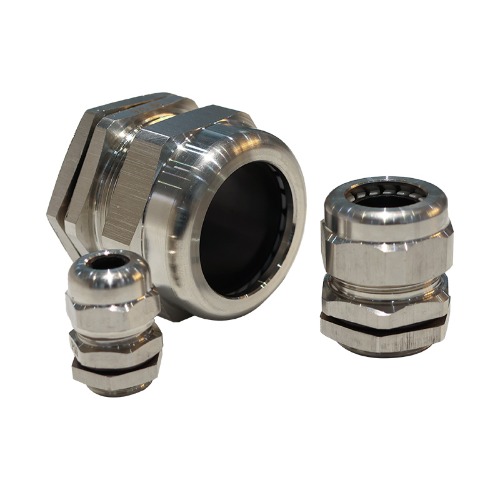
2. Can a gland be reused after disassembly?
A recurring concern is whether you can remove a gland, perhaps replace the cable, and then reinstall it while maintaining sealing and integrity.
Considerations:
The sealing rings (especially O-rings or elastomer inserts) may deform, lose elasticity, or develop wear or compression set.
Threads, particularly on softer materials, may be damaged by repeated installation.
Always inspect all components—body, nut, gasket, sealing ring—before reuse.
If all parts are in good condition (no cracks, deformation, wear), reuse is possible with care. But it’s safer in critical or harsh environments to replace the sealing components or the entire gland to avoid future leaks.
3. How do I ensure waterproof sealing under vibration or movement?
Some installations (machinery, vehicles, dynamic joints) involve motion, vibration, or flexing. The gland must maintain a seal over time under those stresses.
ideal practices:
Use a gland with double-seal or double-compression design to provide redundancy.
Choose high-quality elastomer seals with good fatigue resistance (e.g. FKM, EPDM)
Tighten gradually and check torque after initial usage, as parts may settle
Provide cable support (strain relief or bend radius control) to reduce force on the gland
Periodically inspect and retighten if necessary
Involving a Stainless Steel Cable Gland helps in these scenarios because the rigid metal body is less prone to distortion under mechanical forces.
4. How to choose between 304 vs 316 (or 316L) stainless steel in glands?
Material grade is an important decision. A gland labeled “stainless steel” could be 304. 316. or other grades, and each has different performance in corrosion environments.
304 stainless is suitable for many general indoor or mild environments.
316 / 316L stainless offers better resistance to chloride, marine salt spray, and corrosive chemicals. Many sources highlight this difference.
If your installation is in coastal, offshore, or chemical-exposed sites, lean toward 316 or 316L to reduce corrosion risk.
Additional Tips & Recommendations
Always verify IP / NEMA rating of the gland under realistic conditions of use. Waterproof claims only hold if the installation is proper.
Drill the correct hole size in the enclosure: recommended clearance is often +0.2 mm to +0.7 mm over nominal thread size.
When your cable has connectors (e.g. RJ45. BNC) already attached, many users note that glands aren’t designed to allow pass-through of connectors. The remedy is: insert the cable before attaching the connector.
In multi-cable entries, use proper multi-hole inserts or multiple glands rather than forcing multiple cables through one opening—this reduces sealing stress and cross-interference.

- Add: No. 196, Wei Twelve Road, Economic Development Zone, Yueqing City, Zhejiang Province, China
- Phone: +-86-18967761082
- Fax: +86-577-62056352
- Email: z1721242465@163.com
Contact us now
Copyright © 2024 Pulte Electric Technology (Wenzhou) Co., Ltd. All Rights Reserved

Wholesale Cable Gland and Connector Supplier