

 English
 中文简体
中文简体 Español
 عربى
عربى

Production delays do not always come from complex electrical faults. Sometimes, a small mismatch between a cable entry component and an enclosure can slow down an entire assembly l...
READ MOREChina Wire Clamp
Wire Clamp Manufacturer
-
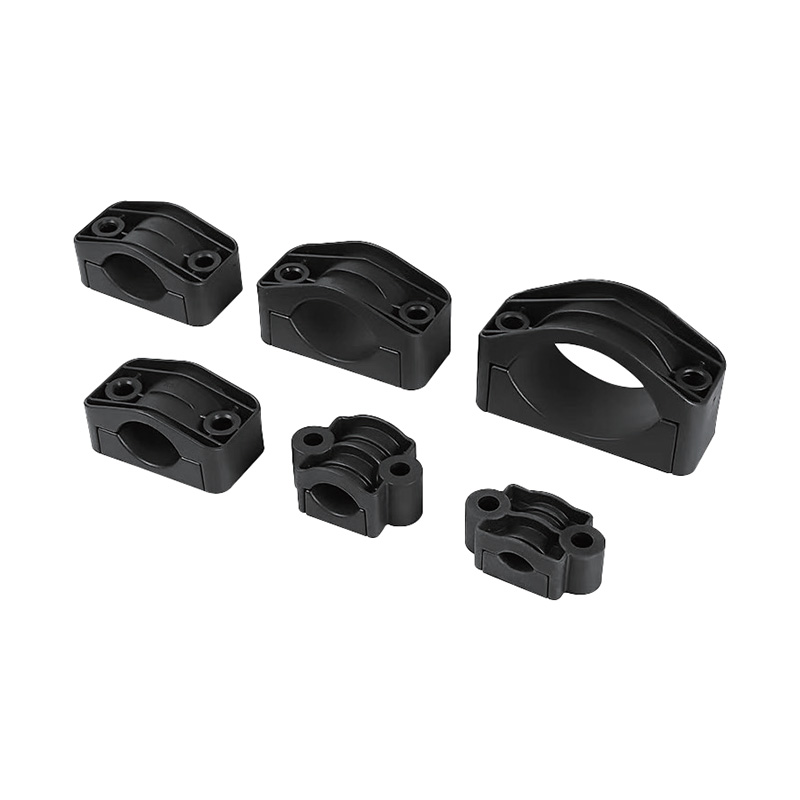
Parameters:
Name Models A(mm) B(mm) C(mm) D(mm) E(mm) Remark Cable Clamps for High Voltage Cabinets (20-36)...read moreBrand:
High Voltage Cable Clamp
-
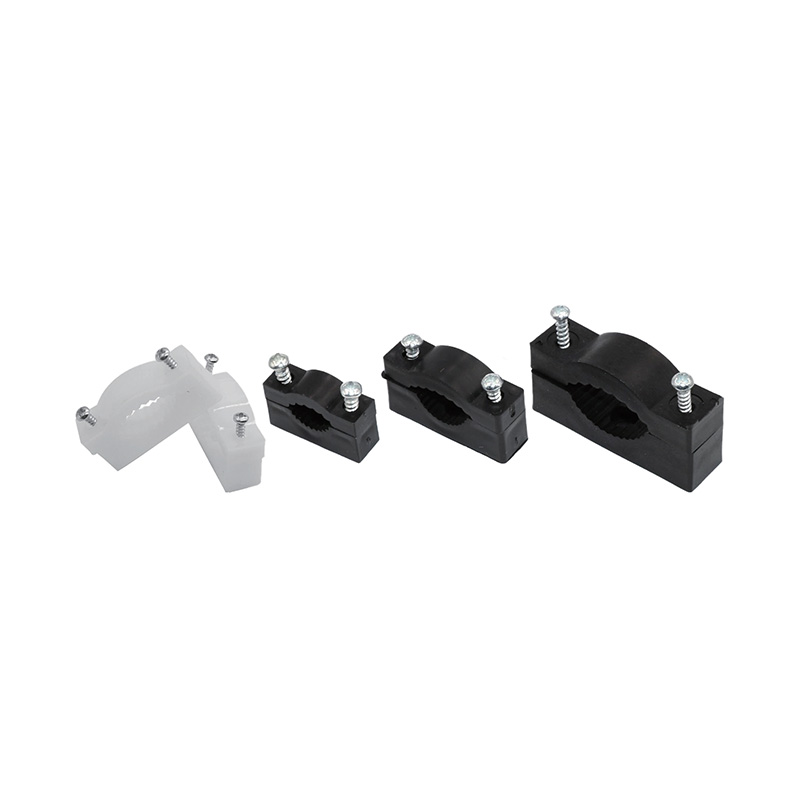
Parameters:
Circular clamp Specification Length width height (cm) Largesize 6*1.7*3.3 medium 4.3*1.4*2.5 ...read moreBrand:
Round Cable Clamp
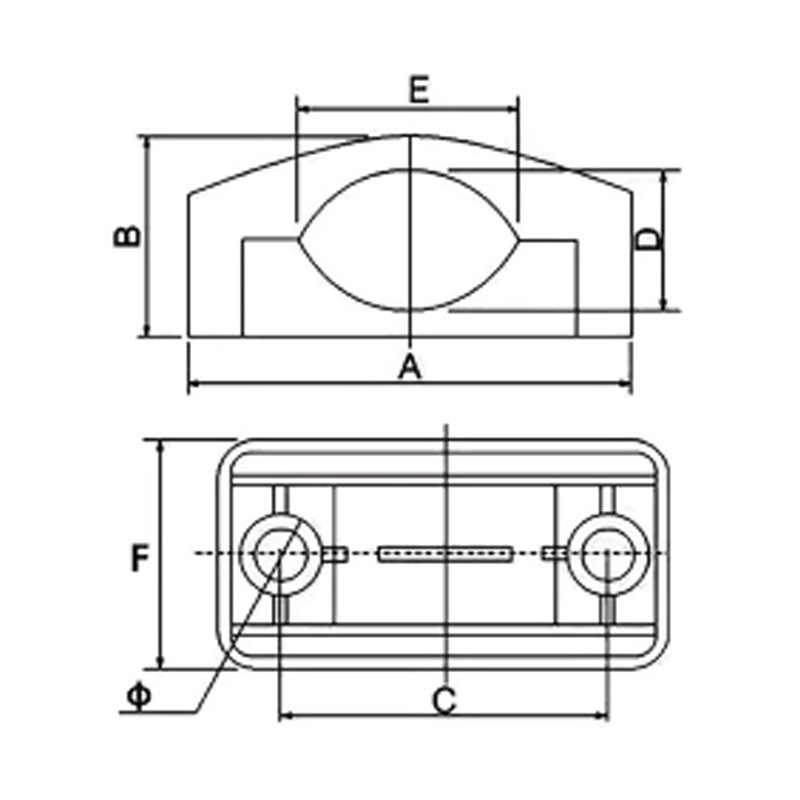
High Voltage Cable Clamp
● Material: High voltage cabinet cable clamp adopts flame retardant nylon 66, good flame retardant performance, high toughness, durable high temperature, not easy to harden.
| Name | Models | A(mm) | B(mm) | C(mm) | D(mm) | E(mm) | Remark |
| Cable Clamps for High Voltage Cabinets | (20-36)mm2 | 90 | 43 | 60.5 | 22 | 22 | Extra Small |
| (30-52)mm2 | 110 | 49.5 | 75 | 32.7 | 32.7 | Small | |
| (50-70)mm2 | 114.5 | 52.6 | 83.5 | 36 | 36 | Medium | |
| (70-95)mm2 | 128 | 66 | 96 | 46.7 | 46.7 | Large | |
| (90-120)mm2 | 150 | 85 | 120 | 65 | 65 | Extra Large |
Round Cable Clamp
● Material: High voltage cabinet cable clamp adopts flame retardant nylon 66, good flame retardant performance, high toughness, durable high temperature, not easy to harden.
| Circular clamp | Specification Length width height (cm) |
| Largesize | 6*1.7*3.3 |
| medium | 4.3*1.4*2.5 |
| trumpet | 3.2*1.1*2.1 |
About Us
Pulte Electric Technology (Wenzhou) Co., Ltd.
Pulte Electric Technology (Wenzhou) Co., Ltd. is a China Custom Wire Clamp Manufacturer and Sale Wire Clamp Factory specializing in producing cable connectors, waterproof junction boxes, and other electrical product accessories. The company was born in the electrical town known as the "China Electrical Capital". It is a professional modern enterprise integrating R&D, production, and sales. Focusing on the brand building of Pulte "PULTE", with excellent technical crispness and efficient quality assurance, satisfactory and thoughtful sales service, and reasonable and affordable prices, its various technical indicators and product performance are better than its peers, and are widely used in junction boxes, distribution cabinets, communication equipment, instruments, and meters, medical equipment, machine tools, artificial intelligence, automation equipment, and other fields: constantly innovating, developing new products, forming a series of waterproof cable connectors, waterproof junction boxes, cold blocking parts, cable connector accessories, hose waterproof connectors and other products. At the same time, Wenzhou Pulte International Trade Co., Ltd., a subsidiary of the company, actively expands the international market and is committed to providing high-quality products and services to global customers, effectively broadening the company's market channels, enhancing market competitiveness, and laying the foundation for expanding the scale of the enterprise.
The company has strong technical strength and is jointly established by industry veterans. It has a professional position in the field of cable connector manufacturing. We have a complete quality assurance system and rich design and manufacturing experience. Our products are widely used in various industries and are highly reliable. We provide professional and high-quality cable-supporting products for customers. We believe that there is a product that meets your needs in our complete series of products.
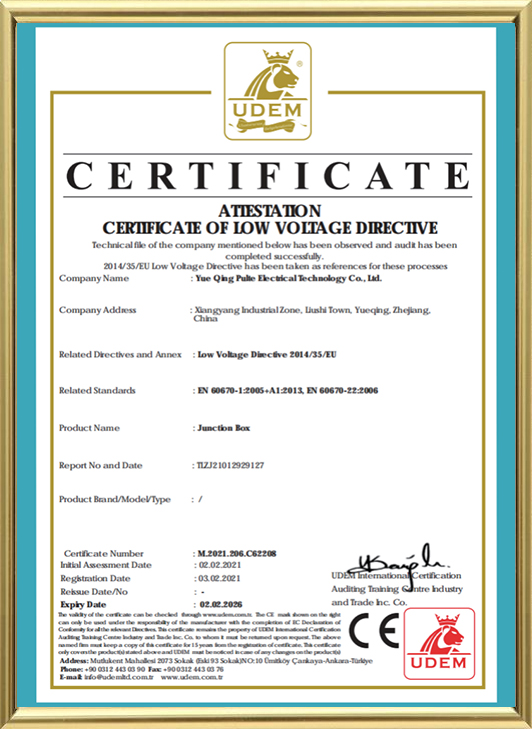
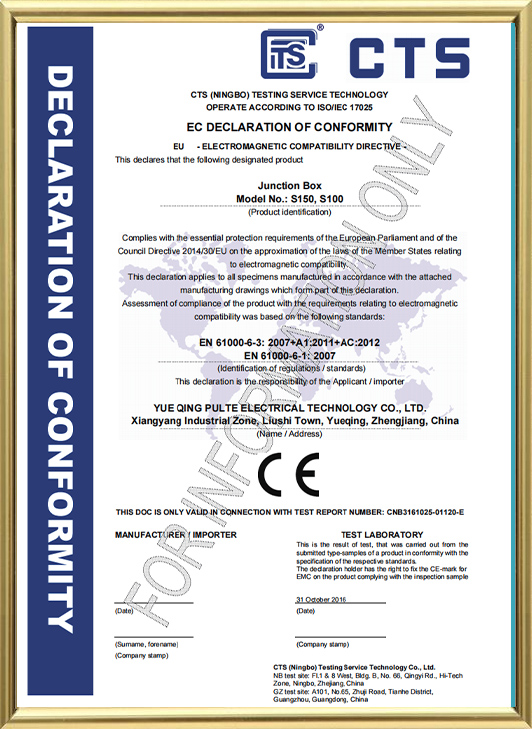
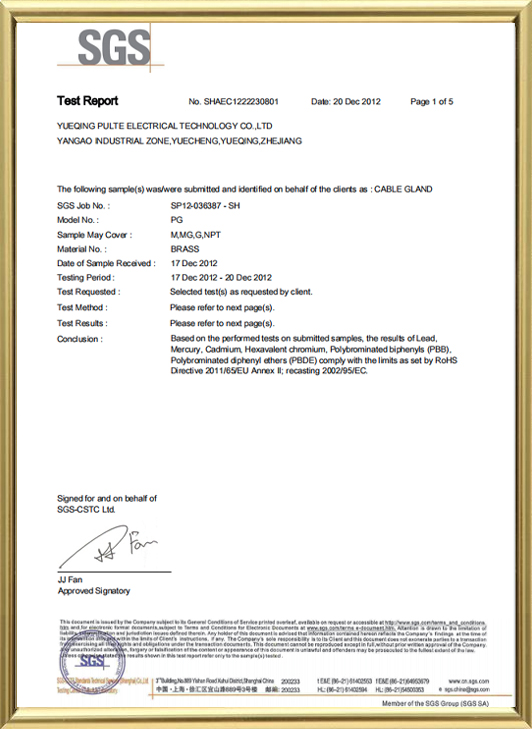
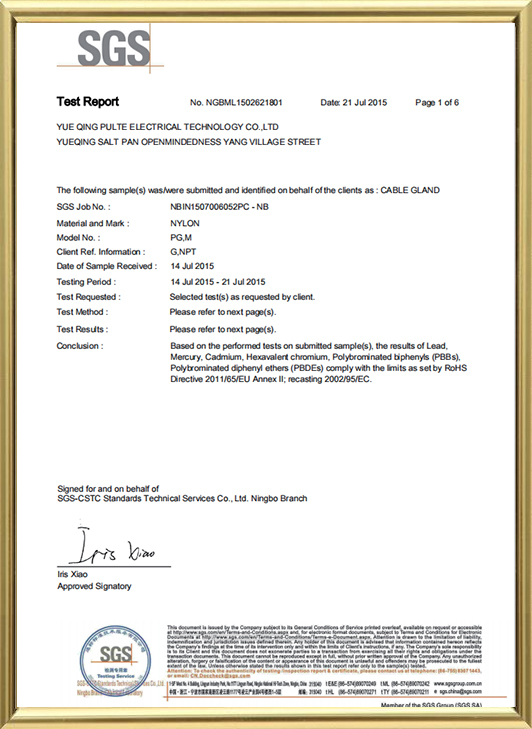
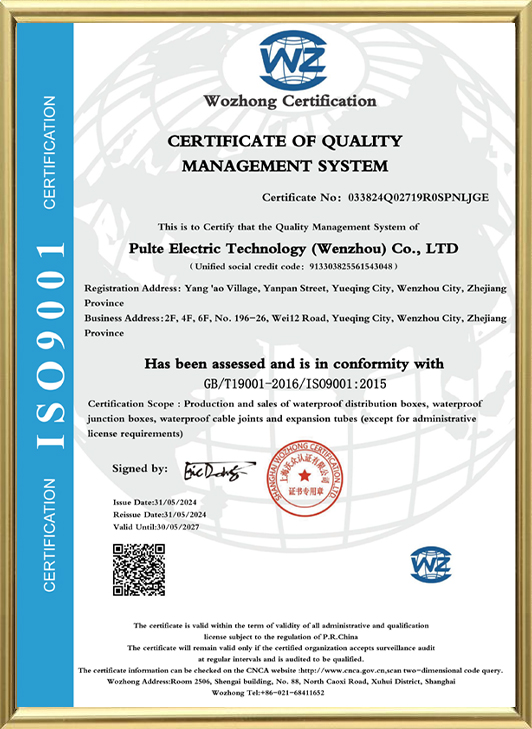
Certificate Of Honor
News
-
-
A Brass Cable Connector plays an important role in maintaining secure cable entry, protecting wiring, and supporting reliable electrical installations. When connections become loos...
READ MORE -
A Brass Cable Connector plays a practical role in keeping electrical cables securely terminated in control cabinets, machinery, power equipment, and industrial wiring systems. As a...
READ MORE -
A Brass Cable Connector can provide a secure cable entry for industrial equipment, but its performance also depends on how the connector is installed. For control cabinets, junctio...
READ MORE
Industry Knowledge Extension
What Types of Wire Clamps Can Be Classified Into?
Wire clamps are essential components in electrical installations, providing secure fastening, strain relief, and organization for wires and cables. They can be classified into several types depending on their structure and application.
1. Screw-Type Wire Clamps
Screw-type wire clamps are one of the common types. They use screws to hold the wire firmly in place, ensuring a stable connection.
Features:
- Adjustable tightening force.
- Suitable for both solid and stranded wires.
- Advantage: Provides reliable mechanical and electrical contact, reducing the risk of loose connections.
- Applications: Residential wiring, electrical panels, and small machinery.
2. Spring Wire Clamps
Spring wire clamps use spring tension to secure wires. They are often found in modern terminal blocks and modular connectors.
Features:
- Quick installation without tools.
- Maintains consistent pressure on wires.
- Advantage: Reduces installation time and minimizes human error in tightening.
- Applications: Control systems, switchgear, and automation equipment.
3. Push-In Wire Clamps
Push-in wire clamps allow wires to be inserted directly into a slot where they are held by internal metal contacts.
Features:
- Tool-free installation.
- Compact design for tight spaces.
- Advantage: Simplifies wiring in high-density installations.
- Applications: Lighting systems, distribution boards, and electronics.
These three types—screw, spring, and push-in—cover common industrial, commercial, and residential applications, providing flexibility, safety, and efficiency in cable management.
What Standards Should a High-Voltage Cable Clamp Meet?
High-voltage cable clamps are used in systems where electrical safety, stability, and performance are critical. They must comply with rigorous standards to ensure long-term reliability.
1. Electrical Insulation Standards
High-voltage clamps must have insulation properties to prevent short circuits, leakage currents, and electrical breakdown. They often conform to IEC 60502, IEEE, or national standards that define insulation resistance, voltage withstand, and dielectric strength.
2. Mechanical Strength Standards
Mechanical durability is crucial for high-voltage clamps. They must resist vibration, impact, and cable tension over time. Standards such as IEC 61914 and ASTM provide guidance on load-bearing capacity, tensile strength, and long-term stability under mechanical stress.
3. Environmental and Safety Standards
High-voltage clamps are often exposed to outdoor or harsh conditions. They must resist UV radiation, moisture, and temperatures. IP ratings (e.g., IP65 or IP68) are commonly used to ensure dust and water resistance. Additionally, compliance with fire safety and corrosion resistance standards guarantees operational reliability in diverse environments.
By meeting electrical, mechanical, and environmental standards, high-voltage cable clamps maintain safety and performance in industrial, utility, and renewable energy applications.
What Is the Sound Field Process of a Round Cable Clamp?
The sound field process of a round cable clamp refers to how the clamp interacts acoustically and mechanically during installation and operation. It can be understood in three main aspects:
1. Vibration Absorption
Round cable clamps are designed to minimize vibration transmitted from cables to mounting surfaces. Proper damping reduces mechanical noise, prevents cable fatigue, and protects sensitive components. Materials like rubber or polymer inserts are often used to enhance vibration absorption.
2. Resonance Control
The geometry of a round cable clamp influences its natural frequency. Optimizing the clamp’s shape and material prevents resonance, which could amplify noise or damage the cable. Engineers test clamps in acoustic chambers or simulation software to ensure stable resonance behavior.
3. Sound Insulation
In certain applications, round cable clamps act as a barrier to airborne or structure-borne sound. Using dense or layered materials, the clamp isolates vibration from machinery or cable bundles. This is especially important in high-precision environments like data centers, industrial equipment, or transportation systems.
Together, vibration absorption, resonance control, and sound insulation form the sound field process, ensuring that round cable clamps maintain mechanical stability while reducing acoustic impact.

- Add: No. 196, Wei Twelve Road, Economic Development Zone, Yueqing City, Zhejiang Province, China
- Phone: +-86-18967761082
- Fax: +86-577-62056352
- Email: z1721242465@163.com
Contact us now
Copyright © 2024 Pulte Electric Technology (Wenzhou) Co., Ltd. All Rights Reserved

Wire Clamp Factory